The most dangerous version of an AI agent is not the one that fails loudly.
It is the one that works just well enough for everyone to stop thinking.
That is the quiet threshold leaders are now approaching.
AI agents can draft, summarize, search, classify, monitor, recommend, route, and increasingly execute parts of work that once required human attention. They can move information faster than a team can discuss it. They can hold workflow state. They can surface patterns. They can take routine operational pressure off people who are already stretched thin.
That is real progress.
But speed has a shadow.
When an agent becomes fast, polished, and useful, the organization can begin to confuse usefulness with authority. A recommendation becomes a default. A generated answer becomes the position of the team. A workflow action becomes a decision no one remembers making. The system moves, and people adapt to its movement.
That is where leadership either sharpens or disappears.
Leading with agents does not mean letting agents lead the organization.
It means designing an organization where agents can do meaningful work without displacing the judgment, responsibility, and moral authority that belong to leadership.
Human Authority Is Not Micromanagement
Human authority is often misunderstood.
It is not the need to approve every sentence, click every button, or stand nervously over every workflow. That kind of control will not scale. It will exhaust leaders and frustrate teams. Worse, it will make AI adoption feel like theater: tools everywhere, trust nowhere.
Human authority means something deeper.
It means the organization knows who has the right to define intent, set boundaries, approve risk, interpret consequences, and remain accountable when the work affects people, money, reputation, trust, or law.
Authority is not the opposite of automation.
Authority is what makes automation governable.
An AI agent can execute a task, but it should not silently inherit the authority to decide what matters. It can generate a recommendation, but it should not quietly become the source of organizational truth. It can manage a process, but it should not erase the human chain of responsibility around that process.
This is especially important as organizations move from using AI as a tool to using agents as operating participants.
A tool waits.
An agent moves.
That movement changes the leadership problem.
Where Authority Gets Lost
Authority is rarely lost in a dramatic moment.
It is usually lost through convenience.
A team starts by using AI to create first drafts. Then it uses AI to summarize customer concerns. Then it uses AI to prioritize which issues matter. Then it uses AI to recommend who should respond. Then it uses AI to produce the response. Eventually, the team is still involved, but less and less of the workflow is being consciously judged by a person with clear ownership.
No one intended to surrender authority.
They just kept accepting the next efficiency.
That is how drift happens.
In agent-enabled environments, leaders need to watch for four authority leaks.
The first is decision drift. This happens when recommendations become decisions because no one pauses long enough to distinguish the two.
The second is accountability fog. This happens when work is produced by a mix of human and machine activity, but no one can clearly say who owns the final judgment.
The third is workflow hiding. This happens when an agent performs steps inside a process that are technically efficient but invisible to the people affected by the result.
The fourth is symbolic misreading. This happens when the organization treats a decision as operational while employees, customers, or stakeholders experience it as relational, ethical, or cultural.
That last one matters more than many leaders realize.
Organizations do not lose trust only because they make bad technical decisions. They lose trust when people feel that leadership has stopped understanding the human meaning of its decisions.
Agents Need Operating Boundaries
Every serious agentic workflow needs operating boundaries.
Not vague encouragement. Not a policy document buried in a compliance folder. Not a cheerful slide saying humans remain in control.
Actual boundaries.
Leaders should be able to answer these questions clearly:
- What is this agent allowed to do?
- What is this agent not allowed to do?
- What data can it use?
- What tools can it call?
- What actions require human review?
- What actions require human approval before execution?
- What exceptions must be escalated?
- Who owns the outcome?
- How is the work logged?
- How can a person challenge or reverse the result?
This is not bureaucracy for its own sake.
This is the architecture of trust.
Without boundaries, agents become improvisational infrastructure. They may still produce value, but the organization slowly loses the ability to explain how work is being done and who is responsible for it.
That is not leadership.
That is operational fog wearing a productivity badge.
The Real Issue Is Not Human Versus AI
The tired debate is whether humans or AI should be in charge.
That is too blunt.
The better question is: what kind of authority belongs where?
AI agents can hold procedural authority inside defined workflows. They can be authorized to gather information, prepare options, reconcile records, draft communications, detect anomalies, route tasks, or initiate narrow actions within approved constraints.
Human leaders must retain interpretive and accountable authority. They must define purpose, approve risk, understand impact, handle exceptions, communicate meaning, and take responsibility for the consequences of the system they chose to deploy.
That distinction matters.
Agents can increasingly run the work.
Leaders must still govern the meaning, boundaries, and consequences of the work.
This is also why agentic systems should not be treated as fancy productivity features. They are operating structures. They change who sees what, who decides what, who acts when, and who carries responsibility afterward.
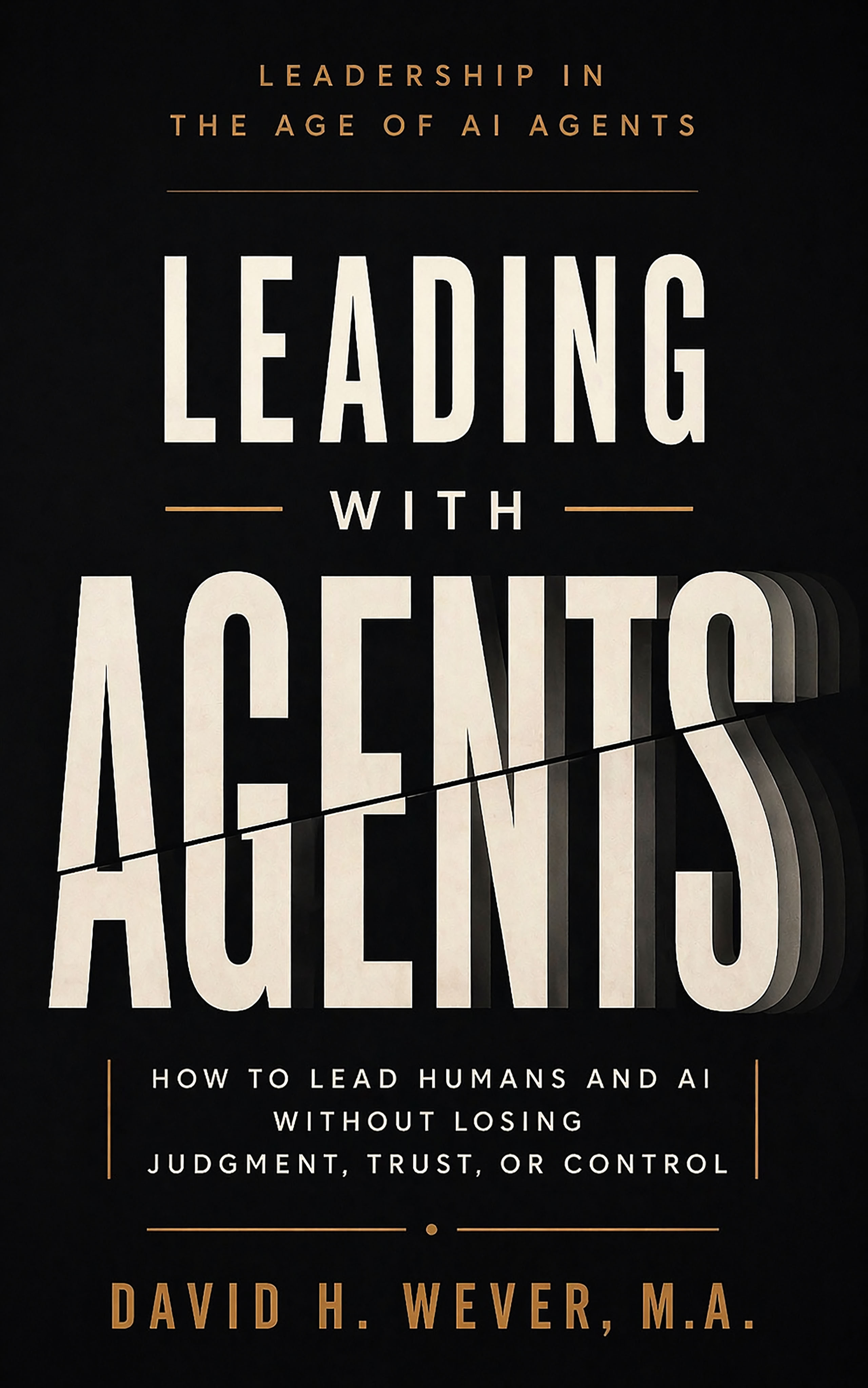
That is the terrain I explore in Leading With Agents. The point is not to fear agents. The point is to lead clearly enough that agents make the organization more capable without making its judgment thinner.
From Human-Centered To Authority-Centered Design
Many organizations say they are keeping humans in the loop.
That phrase is becoming too easy.
A human can be technically in the loop and still function as a rubber stamp. A manager can approve something without understanding it. A team can review output without knowing the assumptions behind it. A leader can sign off on an agentic workflow without grasping how much authority has already been transferred into the system.
The better standard is not merely human-in-the-loop.
The better standard is authority-centered design.
Authority-centered design asks where judgment lives inside the workflow.
It asks where approval is meaningful and where it is performative.
It asks what the agent can do independently and what must remain reviewable.
It asks how people know when the system is assisting them, when it is shaping them, and when it is quietly deciding for them.
It asks whether leadership can explain the system in plain language.
If leaders cannot explain where authority lives, the organization is not ready to scale the agentic workflow.
That may sound severe.
Good.
Some thresholds should not be crossed casually.
What Wever Labs Is Building Toward
This is also part of the broader direction behind Wever Labs.
Wever Labs is being built around agentic operating infrastructure: systems where agents can receive work, route it, perform operational tasks, preserve state, generate outputs, surface exceptions, and return results inside defined boundaries.
That future will not be won by organizations that merely sprinkle AI into existing workflows.
It will be won by organizations that design agentic operating systems with enough clarity for agents to work and enough authority structure for leaders to remain accountable.
The more agentic the system becomes, the more important the operating logic becomes.
What is the agent for?
What does it know?
What can it touch?
What must it refuse?
What must it escalate?
What does it log?
What does it return?
Who owns the result?
These are not side questions. They are the foundation.
Leading With Agents Requires New Executive Discipline
Leaders do not need to become machine learning engineers.
They do need to become more disciplined about authority, trust, and workflow design.
They need to know when an agent is assisting a human and when it is effectively shaping a decision. They need to know which workflows involve reputational exposure, employee impact, financial risk, legal sensitivity, or customer trust. They need to know where people can interrupt the system without being treated as inefficient.
They also need to resist the seduction of clean dashboards.
Dashboards can show throughput.
They do not always show quiet fear.
They can show cycle time.
They do not always show the moment a team stops questioning the system.
They can show fewer manual steps.
They do not always show whether accountability has become harder to locate.
AI agents will make some organizations stronger.
They will make others faster and more brittle.
The difference will not be the technology alone.
The difference will be leadership.
The Future Belongs To Leaders Who Can Authorize Without Abdicating
The next era of work will not be less agentic.
Agents will increasingly coordinate tasks, monitor workflows, interact with systems, and communicate with other agents. The organization will become more computational, more distributed, and more automated.
That does not make leadership obsolete.
It makes weak leadership more dangerous.
The leader’s job is no longer only to manage people through change. It is to design authority into the operating fabric of the organization so that capable systems can act without making responsibility disappear.
Use agents.
Let them do real work.
Build for speed where speed belongs.
But do not confuse movement with wisdom.
Do not confuse output with judgment.
Do not confuse automation with authority.
The future will need leaders who can authorize agents without abdicating responsibility.
That is the line.
And it is not a small one.
Questions For Leaders
- Where are AI recommendations already becoming default decisions inside your organization?
- Which agentic workflows need clearer authority boundaries before they scale?
- Who owns the outcome when work is produced through a mix of human judgment and agentic execution?
Practical Leadership Action
Create an agent authority charter for one workflow. Define what the agent may do, what it may never do, what requires review, what requires approval, what must be escalated, what must be logged, and who owns the result. Then ask whether a new employee, a customer, and a board member could understand the boundary in plain language.

David H. Wever, M.A.
David H. Wever is a psychotherapist, author, and advisor. His work through Wever Advisory focuses on leadership, AI, trust, human complexity, organizational change, and the deeper human realities beneath technological transition.